Unseen Architects of Digital Convenience: The Intricate Architecture and Logic of PPOB Systems
In the rapidly evolving landscape of digital finance, certain systems operate as the unseen architects of modern convenience, enabling seamless transactions that power daily life. Among these, Payment Point Online Bank (PPOB) systems stand out, especially across Asia, as fundamental pillars supporting a wide array of digital payment services. While end-users experience PPOB as a simple interface for paying bills or topping up services, beneath this veneer lies an intricate architecture and sophisticated logic that meticulously orchestrates every transaction. This article delves into the profound complexity behind the apparent simplicity of PPOB systems, exploring how their robust design facilitates financial inclusion and drives digital transformation, particularly in emerging markets.
The unique perspective here is to unveil the hidden sophistication of PPOB. It’s not merely a payment gateway; it's a comprehensive ecosystem designed to bridge disparate financial services and bring them closer to the user. From utilities to mobile top-ups, PPOB streamlines processes that were once cumbersome, making financial services accessible even to populations with limited access to traditional banking. This accessibility is a testament to the system's underlying structure and logical precision, which ensures efficiency, security, and scalability across diverse operational environments.
Beyond the Transaction: Deconstructing PPOB's Core Purpose
At its heart, a PPOB system is a centralized platform that aggregates various billers and service providers, allowing users to make payments through a single point of access. Originating largely from the need to simplify utility bill payments in regions with vast geographical spread and varying levels of digital literacy, PPOB has expanded to encompass a multitude of services: electricity, water, telephone, internet, credit purchases, e-wallet top-ups, and more. This aggregation simplifies the user experience, eliminating the need to interact directly with multiple service providers.
The genius of PPOB lies in its ability to abstract away the complexity of integrating with numerous, often legacy, systems of billers and banks. For the operator, it means a unified interface for managing a diverse portfolio of services; for the consumer, it means unparalleled convenience. This role as a financial aggregator and facilitator is what makes the intricate architecture and logic of PPOB systems the digital backbone of many economies.
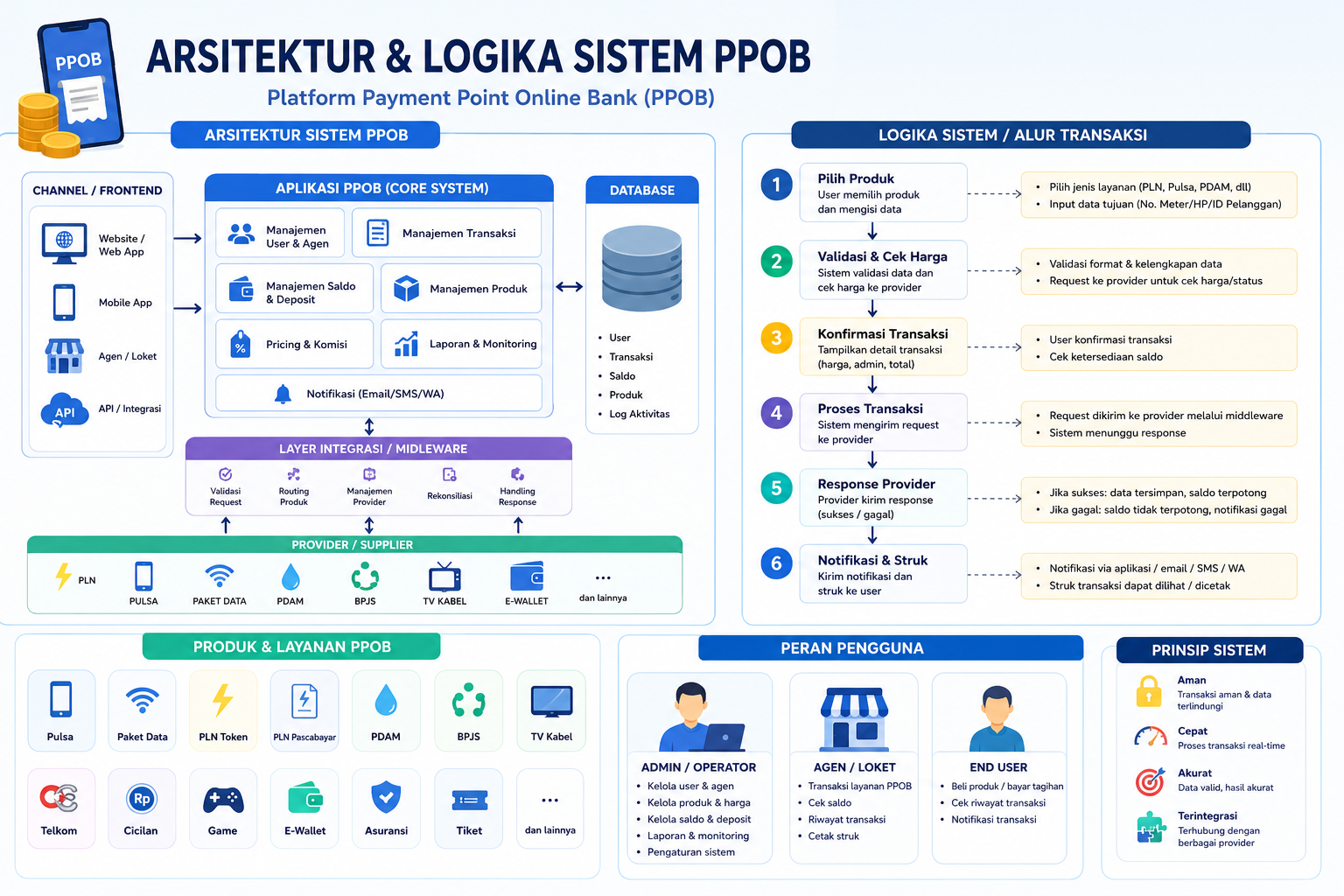
The Blueprint: A Deep Dive into PPOB System Architecture
A typical PPOB system is a multi-layered, distributed architecture designed for high availability, security, and scalability. Understanding its components reveals why it functions so effectively:
1. User Interface (UI) Layer: The Gateway to Simplicity
This is the visible front-end that users interact with. It can manifest as mobile applications, web portals, physical kiosks, or even simple USSD (Unstructured Supplementary Service Data) menus for feature phones. The UI layer focuses on user experience, offering intuitive navigation, clear transaction flows, and real-time feedback. Its primary function is to collect user input (e.g., biller ID, account number, payment amount) and display transaction status, abstracting all the underlying complexities.
2. API Gateway & Integration Hub: The Nerve Center
Positioned between the UI layer and the core processing engine, the API Gateway acts as the primary entry point for all requests. It handles authentication, authorization, request routing, and often rate limiting. More critically, it serves as the Integration Hub, managing connections to various external entities:
- Biller APIs: Each service provider (electricity company, telecom, etc.) has its own API for querying bills and receiving payments. The PPOB system must integrate with potentially hundreds of these disparate APIs, standardizing the communication.
- Payment Gateway APIs: To process actual monetary transfers, the PPOB system integrates with banks, e-wallets, and other payment service providers. This ensures diverse payment options for users.
3. Core Transaction Processing Engine: The Brain
This is the analytical and operational heart of the PPOB system. It houses the primary business logic and performs critical functions:
- Transaction Validation: Verifying the integrity and legitimacy of each request (e.g., correct account numbers, sufficient funds).
- Routing Logic: Directing payment requests to the appropriate biller and payment channel based on predefined rules and agreements.
- Business Rules Management: Applying specific rules for commissions, fees, discounts, and promotional offers.
- State Management: Tracking the status of each transaction through its lifecycle (pending, processing, successful, failed).
- Error Handling & Retries: Implementing robust mechanisms to manage failures and ensure transaction integrity, often with automated retry logic.
4. Database & Data Management: The Memory Bank
Behind every transaction is a wealth of data. The database layer stores essential information:
- User Data: Account details, transaction history, preferences.
- Biller Data: Integration parameters, service catalogs, pricing.
- Transaction Logs: Detailed records of every single operation, crucial for auditing, reconciliation, and troubleshooting.
- Inventory/Product Data: For services like mobile top-ups or game vouchers, managing stock and availability.
5. Security & Compliance Framework: The Guardian
Given the financial nature of PPOB systems, security is not just a feature but a foundational requirement. This layer encompasses:
- Encryption: Protecting data in transit and at rest using industry-standard protocols (e.g., SSL/TLS, AES-256).
- Fraud Detection Systems: Employing algorithms and rules to identify and prevent suspicious activities.
- Access Control: Implementing role-based access to ensure only authorized personnel can access sensitive data and functions.
- Compliance: Adhering to local and international financial regulations (e.g., PCI DSS, local central bank guidelines) and data privacy laws.
6. Reporting & Analytics Module: The Insight Generator
This module provides insights into operational performance, financial reconciliation, and business trends. It generates reports for:
- Transaction Reconciliation: Matching payments received with services delivered and funds transferred to billers.
- Performance Monitoring: Tracking transaction volumes, success rates, and system uptime.
- Business Intelligence: Identifying popular services, peak transaction times, and user behavior patterns to inform strategic decisions.
The Logic Unveiled: Tracing a PPOB Transaction Flow
To appreciate the intricate logic, let's trace a typical bill payment scenario:
- User Initiation: A user opens a PPOB app, selects "Electricity Bill," enters their account number, and requests a bill inquiry.
- UI to API Gateway: The app sends the request to the PPOB's API Gateway. The Gateway authenticates the user and routes the request to the Core Transaction Processing Engine.
- Core Engine & Biller Integration: The Core Engine identifies the relevant electricity biller based on the account number's prefix or user selection. It then formulates a bill inquiry request according to the specific API specifications of that electricity provider.
- External Biller Response: The electricity provider's system processes the inquiry and returns the bill details (amount due, due date) back to the PPOB Core Engine via its API.
- Display & Confirmation: The Core Engine relays these details back through the API Gateway to the user's app. The user reviews the bill and confirms payment.
- Payment Processing: Upon confirmation, the Core Engine initiates the payment process. It checks the user's selected payment method (e.g., e-wallet, bank transfer), validates funds, and instructs the Payment Gateway to process the deduction.
- Transaction Settlement & Notification: The Payment Gateway processes the payment and confirms it back to the PPOB Core Engine. Concurrently, the Core Engine sends a payment confirmation to the electricity provider via its API and updates its own transaction logs.
- User Confirmation & Receipt: Finally, the user's app displays a successful payment notification and often provides a digital receipt.
This seemingly simple flow involves multiple asynchronous communications, data validations, and state changes, all managed by the PPOB system's sophisticated logic. The "seamless" experience is a direct result of this hidden choreography.
The Silent Challenges and Ingenious Solutions
The architects of PPOB systems face significant challenges:
- Scalability & Performance: PPOB systems must handle millions of transactions concurrently, especially during peak hours. This requires highly optimized code, efficient database management, and cloud-native architectures that can scale horizontally.
- Robust Security Measures: Protecting sensitive financial data and preventing fraud is a continuous battle. Multi-factor authentication, AI-driven anomaly detection, and regular security audits are vital.
- Interoperability Across a Fragmented Landscape: Integrating with hundreds or thousands of billers, each with unique APIs and protocols, is a monumental task. The PPOB system acts as a universal adapter, normalizing data and commands. This is part of the rahasia di balik efisiensi pembayaran digital that PPOB offers.
- Real-time Processing and Reconciliation: Ensuring immediate transaction confirmation while maintaining accurate financial records across all parties (user, PPOB, biller, bank) requires sophisticated asynchronous processing and robust reconciliation engines.
- Fault Tolerance & Resilience: The system must be designed to withstand component failures without interrupting services, employing redundant servers, failover mechanisms, and comprehensive monitoring.
PPOB as an Engine for Digital Transformation
Beyond the technical marvel, PPOB systems play a pivotal role in socio-economic development. By making essential services easily payable, they reduce the burden of travel, queues, and traditional banking hours, saving time and money for millions. They empower small businesses to become payment points, fostering micro-entrepreneurship. In regions where a significant portion of the population is unbanked or underbanked, PPOB acts as a crucial bridge, introducing them to digital financial services and laying the groundwork for broader financial inclusion.
Future Trajectories: Evolving the PPOB Paradigm
The evolution of PPOB continues. Future enhancements may include deeper integration with Artificial Intelligence for personalized service recommendations and fraud prediction, leveraging blockchain for enhanced transparency and immutable transaction records (though this is more prevalent in specific niches like cross-border remittances or digital asset management rather than traditional PPOB for now), and greater emphasis on open banking APIs for seamless financial data sharing with user consent. The core challenge will always remain: to continually simplify the user experience while managing increasing complexity behind the scenes.
Conclusion: The Enduring Legacy of Invisible Innovation
The architecture and logic of PPOB systems represent a triumph of engineering aimed at delivering universal convenience. While often overlooked by the average user, their intricate design, robust security, and seamless integration capabilities are what empower millions to navigate their financial lives with unprecedented ease. PPOB systems are not just about processing payments; they are about connecting communities, fostering economic growth, and acting as the silent, yet powerful, architects of a more inclusive and digitally-enabled future. Their continued refinement will undoubtedly shape the next generation of digital financial services, making the once complex, truly effortless.