Navigating the Digital Horizon: The 2026 Technology Trends That Are Shaping Tomorrow
In a world where every keystroke and sensor feeds a growing data stream, the pace of technological evolution feels like a sprint rather than a marathon. The year 2026 has already witnessed a convergence of breakthroughs that blur the line between science fiction and everyday reality. From AI‑driven city planning to quantum‑enhanced logistics, the latest tech trends are not merely innovations—they are the invisible architecture that will dictate how we live, work, and play in the coming decade.
1. The Rise of the “Invisible Architecture”
At the core of this transformative wave lies a shift from visible gadgets to the underlying frameworks that make them work. Think of the sprawling cloud infrastructure that powers streaming services, the edge‑computing nodes that enable real‑time AR, or the decentralized ledgers that secure digital identities. These are the invisible architectures—layers of software, protocols, and data that quietly enable the next generation of consumer experiences.
For instance, the latest article on the unseen architecture shaping digital futures dives deep into how multi‑layered AI models, distributed ledger technologies, and hyper‑connected sensors are becoming the backbone of emerging ecosystems. Understanding this foundation is key to anticipating which products will dominate the market and how policy will adapt.
2. Artificial Intelligence: From Narrow to General
Artificial Intelligence continues to be the headline driver of 2026 tech trends, but its trajectory is shifting from specialized “narrow AI” to more generalized, context‑aware systems. The most compelling development is the integration of multi‑modal learning—models that can process text, image, audio, and sensor data simultaneously—into everyday devices.
Large language models (LLMs) are now being fine‑tuned for specific industries such as healthcare, finance, and autonomous transport. In the healthcare sector, AI triage systems can analyze patient vitals, medical imaging, and genomic data in real time to recommend personalized treatment plans. In finance, AI‑driven risk assessment tools parse market sentiment from news feeds, social media, and satellite imagery to forecast economic shifts.
Meanwhile, the emergence of AI‑on‑chip—dedicated hardware accelerators built into CPUs and GPUs—has dramatically reduced inference latency. This has paved the way for real‑time, edge‑based AI applications such as autonomous drones and smart home assistants that can operate offline, ensuring privacy and resilience.
3. Quantum Computing: A New Paradigm for Problem Solving
Quantum computing has moved from theoretical laboratories into practical prototypes. Companies like IBM, Google, and startups are releasing quantum‑as‑a‑service platforms, making it easier for developers to test algorithms that exploit quantum superposition and entanglement.
- Cryptography: Quantum key distribution (QKD) is becoming a standard for securing high‑value communications, especially in financial and defense sectors.
- Optimization: Quantum annealers are solving complex logistics problems, such as route planning for autonomous fleets, far faster than classical algorithms.
- Materials Science: Quantum simulations are accelerating the discovery of novel materials for batteries, semiconductors, and biocompatible implants.
While full‑scale, fault‑tolerant quantum computers are still years away, the early adoption of hybrid quantum‑classical workflows is already delivering tangible benefits.
4. 6G and the Next‑Generation Connectivity
By 2026, 6G is not just a buzzword—it is a reality for many urban centers. Offering data rates up to 1 Tbps, low latency, and massive device density, 6G is enabling:
- Ultra‑realistic augmented reality (AR) experiences that overlay holographic interfaces onto physical environments.
- Seamless telepresence for remote work, allowing workers to feel as if they were physically present in a different location.
- Robust connectivity for Internet of Things (IoT) ecosystems, from smart factories to autonomous vehicles.
Moreover, 6G’s integration with AI at the edge is facilitating predictive maintenance and adaptive traffic management in real time, creating cities that respond dynamically to congestion and environmental conditions.
5. Smart Cities and the Vertical Future
Urban planners and architects are reimagining cityscapes to accommodate growing populations while preserving green spaces. The concept of a vertical city—a multi‑layered metropolis where residential, commercial, and recreational spaces are stacked—has gained traction. This model reduces urban sprawl, optimizes land use, and enhances sustainability.
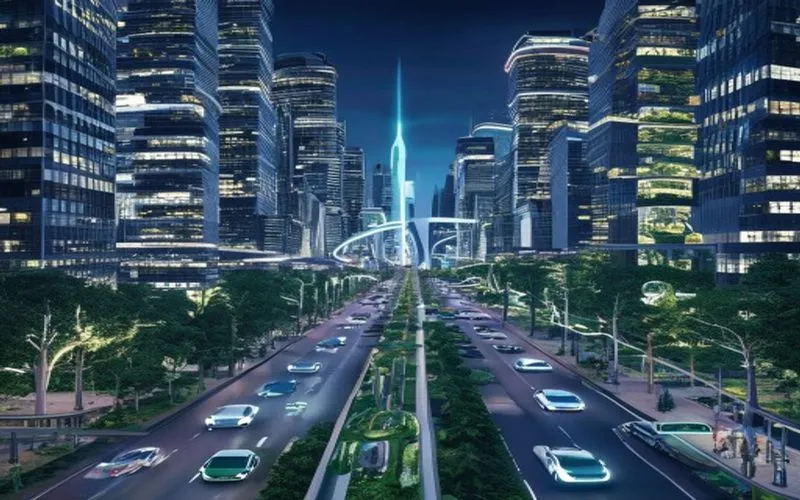
The image above illustrates a city where high‑rise towers host mixed‑use developments, and electric autonomous pods navigate vertical corridors. This vision is supported by:
- Smart energy grids that integrate rooftop solar, wind turbines, and battery storage.
- AI‑optimized traffic flow systems that reduce congestion and emissions.
- Vertical farms that provide fresh produce within city limits, cutting transportation costs and carbon footprints.
Such developments are not merely aesthetic; they represent a shift toward resilient urban ecosystems that can adapt to climate change, pandemics, and demographic shifts.
6. Autonomous Transportation: From Roads to Skies
The transportation sector is experiencing a paradigm shift driven by autonomous vehicles (AVs), hyperloop networks, and drone delivery systems. The combination of AI, sensor fusion, and 6G connectivity is enabling:
- Fully autonomous cars that can negotiate complex traffic scenarios without human intervention.
- Urban air mobility solutions—electric vertical take‑off and landing (eVTOL) aircraft—providing last‑mile connectivity.
- Drone swarms that deliver medical supplies and packages with precision and speed.

The image above showcases a glimpse of the future where autonomous pods glide along invisible railways, and electric vehicles seamlessly integrate into the urban fabric.
7. Sustainability: Tech as the Green Catalyst
Climate change remains a pressing global challenge, and technology is positioned as a critical tool in mitigation and adaptation efforts. Key trends include:
- Carbon‑neutral data centers that use AI to optimize cooling and energy usage.
- Blockchain‑based carbon credit platforms that increase transparency and reduce fraud.
- AI‑driven environmental monitoring systems that provide real‑time data on air quality, water levels, and biodiversity.
By integrating these technologies, companies and governments can track progress toward net‑zero goals with unprecedented accuracy.
8. Cybersecurity in a Hyperconnected World
With the proliferation of IoT devices, autonomous systems, and quantum computing, cybersecurity threats are evolving in sophistication. Emerging defense mechanisms include:
- Zero‑trust architectures that verify every transaction and device interaction.
- AI‑powered threat detection that identifies anomalous behavior in real time.
- Quantum‑resistant cryptographic protocols that safeguard data against future quantum attacks.
These measures are essential to maintaining trust in digital ecosystems, especially as critical infrastructure becomes increasingly automated.
9. The Human Touch: Augmented Creativity and Collaboration
Technology is not just about efficiency—it also enhances human creativity. AI tools are now capable of generating music, visual art, and even literature that rivals human output. Collaborative platforms that blend human intuition with machine intelligence are empowering teams to tackle complex problems more effectively.
Moreover, the rise of mixed reality environments allows remote teams to interact in shared, immersive spaces, fostering collaboration across geographic boundaries.
10. Policy, Ethics, and the Future of Work
As technology reshapes industries, regulatory frameworks must keep pace. Key areas of focus include:
- Data privacy laws that balance innovation with individual rights.
- Ethical guidelines for AI decision‑making, especially in high‑stakes domains like healthcare and criminal justice.
- Workforce retraining programs that prepare workers for roles in AI, quantum computing, and smart infrastructure.
In 2026, governments and corporations are collaborating to create innovation sandboxes where new technologies can be tested responsibly before widespread deployment.
11. Looking Ahead: What 2027 and Beyond May Hold
While the current trends paint a picture of rapid advancement, the next few years will likely see further convergence:
- AI and quantum computing working together to solve complex global challenges.
- Hyper‑connected cities that adapt in real time to environmental and social changes.
- Personalized, AI‑driven health ecosystems that monitor and predict individual health risks.
- Decentralized, peer‑to‑peer energy grids that empower communities to manage their own power.
Staying informed about these developments is not just a matter of curiosity—it is essential for businesses, policymakers, and citizens to navigate the digital future responsibly.
Conclusion
The landscape of 2026 is a tapestry woven from AI, quantum computing, 6G, and sustainable urban design. These technologies, while distinct, are interdependent—each reinforcing the others to create a more efficient, resilient, and human‑centric world. By understanding the invisible architecture that underlies these trends, stakeholders can anticipate opportunities, mitigate risks, and shape a future where technology serves humanity’s grandest aspirations.
For a deeper dive into the hidden layers driving these shifts, you can explore this comprehensive analysis of foundational tech shifts or read about the evolution from AI to vertical cities to see how these concepts converge in real-world applications.