Unveiling the Next Frontier: How AI and Machine Learning Are Reshaping Our Digital Landscape
Introduction: The AI Revolution is Not a Myth
In the past decade, the phrase “Artificial Intelligence” has moved from the realm of sci‑fi novels to the core vocabulary of businesses, governments, and everyday consumers. While the buzzwords “AI” and “Machine Learning” (ML) are often used interchangeably, they represent distinct, yet intertwined, disciplines. AI refers to the broader concept of machines performing tasks that would normally require human intelligence, whereas ML is a subset that empowers those systems to learn from data and improve autonomously.
What makes this field uniquely compelling is its capacity to transcend industry boundaries: from healthcare diagnostics to autonomous vehicles, from personalized marketing to real‑time language translation. The following article explores the mechanisms behind AI/ML, the ethical and economic implications, and the emerging trends that promise to shape the next decade.
1. Foundations of Machine Learning: From Algorithms to Neural Nets
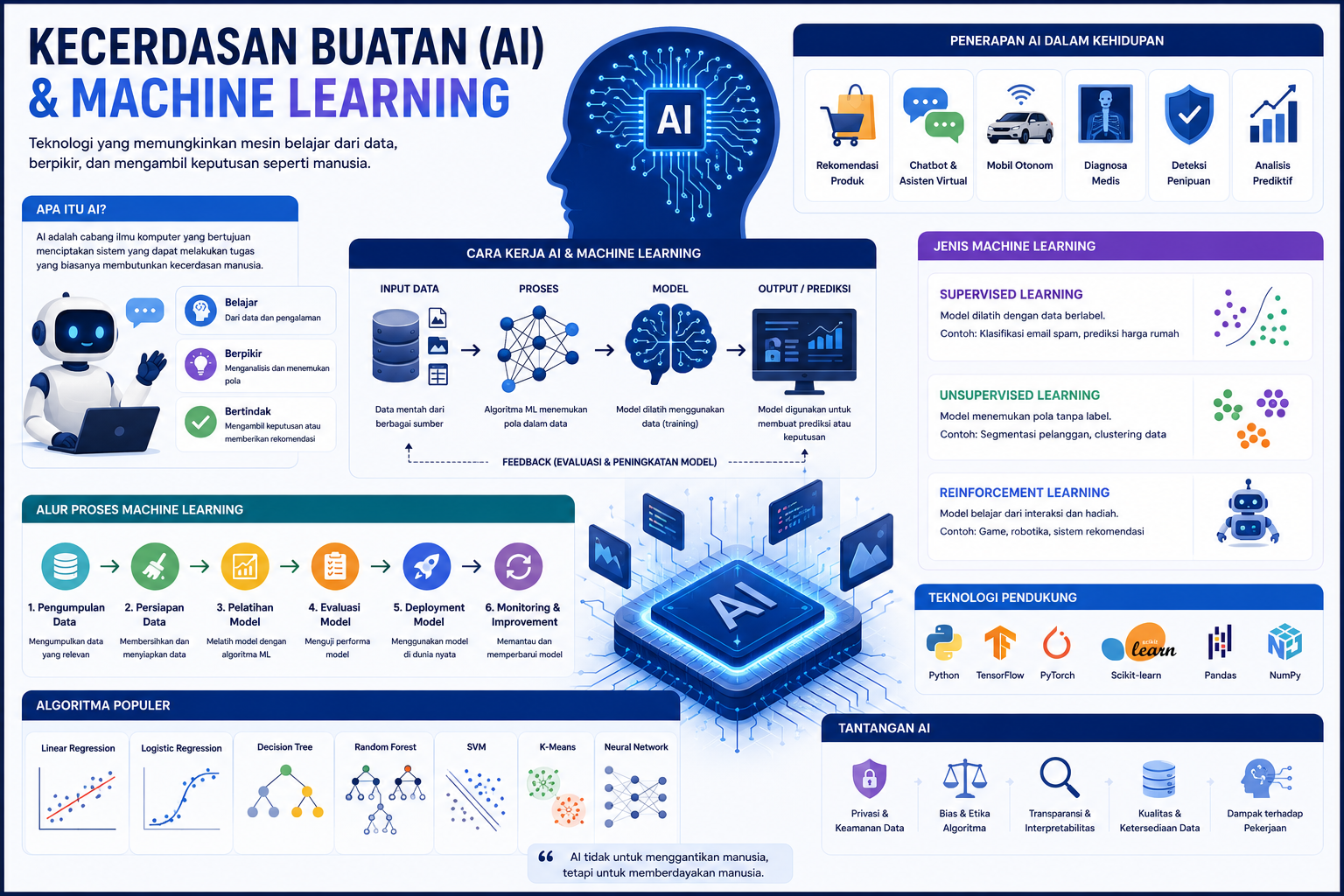
At its core, ML is about pattern recognition. Traditional algorithms like decision trees, support vector machines, and k‑nearest neighbors laid the groundwork for supervised learning. However, the breakthrough came with deep learning—neural networks that mimic the human brain’s layered architecture. Convolutional Neural Networks (CNNs) excel in image recognition, Recurrent Neural Networks (RNNs) and Transformers dominate natural language processing, and reinforcement learning powers autonomous systems.
Data is the lifeblood of ML. Without high‑quality, diverse datasets, models risk overfitting or perpetuating bias. Consequently, data engineering—cleaning, labeling, augmenting—is as critical as model architecture. The recent rise of federated learning also highlights a shift toward privacy‑preserving approaches, allowing models to learn from decentralized data without compromising user confidentiality.
2. AI in the Cloud: Democratizing Intelligence
Cloud platforms have become the backbone of modern AI deployments. By offering scalable GPU resources, managed services, and pre‑built models, providers lower the entry barrier for startups and enterprises alike. This democratization is evident in the surge of AI‑as‑a‑Service (AIaaS) offerings such as Amazon SageMaker, Google Cloud AI Platform, and Azure Machine Learning.
One notable trend is the integration of AI into traditional desktop applications. As highlighted in The Resurgence of Desktop Applications in the Cloud Era, developers are embedding AI features—like predictive text, image enhancement, and real‑time translation—directly into familiar software, blurring the line between local and cloud intelligence.
3. Real‑World Applications: Beyond the Hype
- Healthcare: AI models analyze medical imaging with accuracy rivaling seasoned radiologists, while predictive analytics forecast disease outbreaks.
- Finance: Algorithmic trading, fraud detection, and customer segmentation rely heavily on ML to process vast streams of transactional data.
- Retail: Recommendation engines personalize shopping experiences, and inventory management systems forecast demand using time‑series analysis.
- Manufacturing: Predictive maintenance uses sensor data to anticipate equipment failures, reducing downtime and costs.
- Creative Industries: Generative models produce music, art, and even code, challenging our traditional notions of authorship.
4. Ethical Considerations: Bias, Transparency, and Accountability
With great power comes great responsibility. AI systems can inadvertently encode societal biases present in training data, leading to discriminatory outcomes in hiring, lending, or law enforcement. Transparency tools like explainable AI (XAI) aim to demystify model decisions, but the trade‑off between interpretability and performance remains a hot debate.
Regulatory frameworks are evolving. The European Union’s AI Act proposes a risk‑based approach, classifying applications into unacceptable, high, and low risk categories. In the United States, sector‑specific guidelines are emerging, especially around autonomous vehicles and healthcare diagnostics.
5. The Future Landscape: Edge AI, Quantum Computing, and Beyond
While cloud AI dominates today, the future points toward edge computing—deploying models directly on devices for low latency and offline functionality. This shift is critical for applications like autonomous drones, real‑time translation earbuds, and smart home assistants.
Quantum computing, still in its infancy, promises to solve optimization problems that are currently infeasible for classical computers. Hybrid classical‑quantum ML algorithms could accelerate training times and unlock new capabilities, particularly in drug discovery and materials science.
Moreover, the convergence of AI with other emerging technologies—blockchain for secure data sharing, Internet of Things (IoT) for real‑time sensor fusion—creates a synergistic ecosystem poised to transform industries.
6. How to Get Started: Building a Personal AI Project
- Choose a Problem: Start with a well‑defined question—e.g., classifying spam emails or predicting house prices.
- Gather Data: Utilize public datasets from Kaggle, UCI Machine Learning Repository, or open government portals.
- Select a Framework: Libraries like TensorFlow, PyTorch, or Scikit‑Learn provide robust tools for model development.
- Train & Evaluate: Split data into training, validation, and test sets. Use metrics such as accuracy, precision, recall, or ROC‑AUC to assess performance.
- Deploy: Leverage cloud services or containerization (Docker, Kubernetes) to make your model accessible via APIs.
- Iterate: Continuously refine your model with new data, hyperparameter tuning, and feature engineering.
For deeper insights into how AI is shaping global technology trends, explore 最新のテクノロジートレンド:デジタル時代のイノベーションと未来, which discusses the intersection of AI with other digital innovations.
Conclusion: The AI Imperative
Artificial Intelligence and Machine Learning are no longer optional tools; they are foundational pillars that will dictate competitive advantage in the coming years. Whether you’re a developer, a business leader, or an informed citizen, understanding the mechanics, opportunities, and challenges of AI is essential. As we advance, the focus must shift from merely building smarter systems to ensuring those systems are ethical, transparent, and aligned with human values.
By embracing the potential of AI while rigorously addressing its pitfalls, we can harness this technology to solve complex problems, enhance human creativity, and ultimately build a more equitable digital future.