The Invisible Loom: How Converging Tech Trends Are Weaving Our Future Reality
In a world accelerating at an unprecedented pace, simply keeping up with the latest technology news and trends feels like a full-time job. Yet, to merely list these advancements would be to miss the forest for the trees. The true marvel of our current technological epoch isn't just the individual breakthroughs in Artificial Intelligence (AI), Web3, Quantum Computing, or Biotechnology; it's the profound, often invisible, interplay between them. These diverse threads of innovation are not running in parallel but are intricately weaving together, forming a complex tapestry that is fundamentally redefining our reality, our interactions, and even our understanding of what it means to be human.
We are not witnessing a series of isolated revolutions, but a grand, symphonic evolution where each technological advancement amplifies and accelerates the others. This convergence is creating a future that is not just digitally enhanced, but fundamentally re-architected. Let's delve into this unseen loom, examining how these powerful trends are intertwining to shape the world of tomorrow, today.
The AI Tsunami: More Than Just Smart Algorithms
Artificial Intelligence continues to dominate headlines, but its evolution in recent years has moved far beyond mere automation. We're in the era of generative AI, large language models (LLMs) like GPT-4, and sophisticated image generation tools, which have broken out of academic labs and into the mainstream consciousness. AI is no longer just assisting human tasks; it's creating, synthesizing, and even 'reasoning' in ways that challenge our long-held assumptions about intelligence and creativity.
- Generative AI & Creativity: Tools that can generate text, images, code, and even music from simple prompts are democratizing creation, empowering individuals and small businesses, and fundamentally altering content production pipelines. This has massive implications for industries ranging from marketing and design to software development and entertainment.
- AI in Scientific Discovery: Beyond its creative prowess, AI is revolutionizing scientific research, from accelerating drug discovery and material science to modeling complex climate systems. Its ability to process vast datasets and identify patterns far beyond human capacity is pushing the boundaries of what's knowable.
- Ethical & Societal Implications: The rapid advancement of AI also brings critical questions to the forefront regarding ethics, bias, job displacement, misinformation, and the very nature of human agency. Governments, corporations, and civil society are grappling with how to govern and integrate these powerful tools responsibly, ensuring they serve humanity rather than subjugate it.
The ubiquity of AI, its integration into everything from our smartphones to our critical infrastructure, means it's no longer a distinct technology but an underlying utility, an invisible engine driving countless other innovations.
Web3 and the Decentralized Future: Reclaiming the Digital Commons
While AI focuses on intelligence, Web3 aims to redefine ownership and control in the digital realm. Built upon blockchain technology, Web3 envisions a decentralized internet where users, not corporations, own their data, digital assets, and online identities. It’s a paradigm shift from the current 'Web2' model, dominated by large tech platforms.
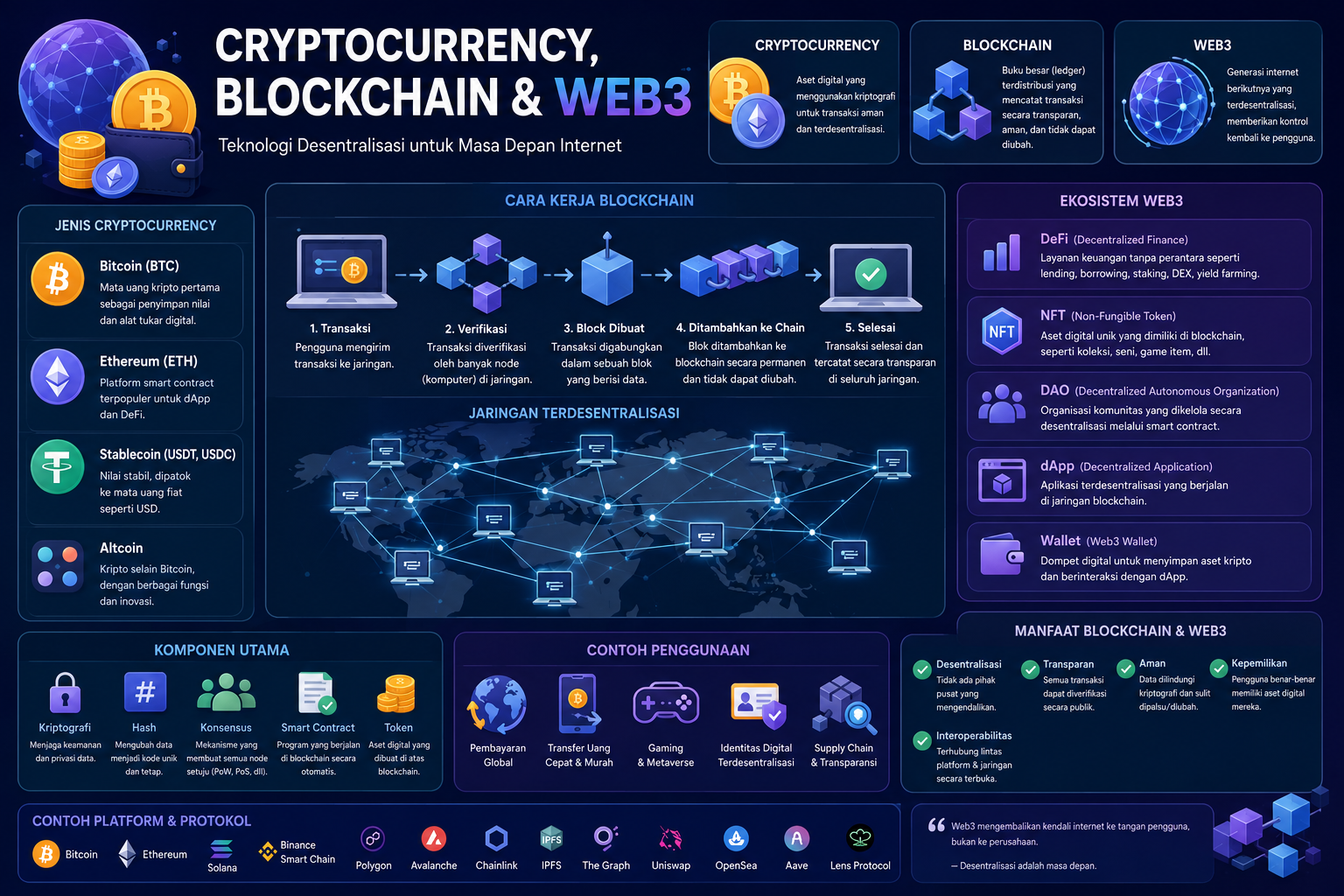
- Blockchain & Distributed Ledgers: The foundational technology of Web3 provides immutable, transparent, and secure record-keeping. While initially known for cryptocurrencies like Bitcoin and Ethereum, its applications now extend to supply chain management, digital identity, voting systems, and much more.
- NFTs & Digital Ownership: Non-fungible tokens (NFTs) have sparked a revolution in digital ownership, demonstrating how unique digital assets – from art to in-game items – can be verifiable and scarce. Beyond speculative art, NFTs are evolving into tools for intellectual property, ticketing, and digital credentials.
- DAOs & Decentralized Governance: Decentralized Autonomous Organizations (DAOs) offer a new model for collective decision-making and resource allocation, where governance is codified in smart contracts and distributed among token holders. This has the potential to reshape traditional corporate structures and even community organization.
- The Metaverse & Immersive Experiences: While not exclusively Web3, the vision of an interoperable, persistent metaverse often hinges on Web3 principles of digital ownership and open standards. It promises a future where our digital lives are as rich and meaningful as our physical ones, moving beyond flat screens into immersive 3D environments.
Web3 is challenging the very architecture of the internet, promising greater user empowerment but also presenting significant technical hurdles, scalability issues, and regulatory complexities. Its success will depend on its ability to move beyond niche applications to offer tangible benefits for everyday users.
Quantum Computing: The Realm of the Improbable
Often dubbed the "next frontier" of computation, quantum computing operates on principles of quantum mechanics – superposition, entanglement, and tunneling – allowing it to tackle problems intractable for even the most powerful classical supercomputers. While still in its nascent stages, its potential implications are staggering.
- Unlocking Complex Problems: Quantum computers could revolutionize fields like materials science (designing new drugs or catalysts), financial modeling (optimizing portfolios), cryptography (breaking existing encryption, but also creating new, unhackable ones), and artificial intelligence (training more sophisticated models).
- Current Status & Challenges: We are currently in the 'noisy intermediate-scale quantum' (NISQ) era, where quantum machines have limited qubits and are prone to errors. Building fault-tolerant quantum computers is a monumental engineering challenge, but progress is steady, with major tech companies and nations heavily investing in research.
- The Quantum-Classical Divide: It's important to note that quantum computing won't replace classical computers; instead, it will complement them, serving as specialized accelerators for specific, incredibly complex computational tasks.
The true impact of quantum computing is still years, perhaps decades, away from widespread application, but its development represents a fundamental shift in our understanding of computation and the limits of what machines can achieve.
Biotechnology & Human Augmentation: Redefining Life Itself
Beyond silicon and algorithms, advances in biotechnology are poised to transform life sciences and human health in profound ways. From editing our genetic code to directly interfacing with our brains, these technologies challenge biological limits.
- CRISPR & Gene Editing: The gene-editing tool CRISPR-Cas9 has made editing DNA simpler, cheaper, and more precise than ever before. This opens doors for curing genetic diseases, developing new crops, and potentially even enhancing human traits, raising profound ethical dilemmas.
- Brain-Computer Interfaces (BCIs): BCIs are no longer science fiction. Devices that allow direct communication between the brain and external devices are being developed for medical applications (restoring movement to paralyzed individuals, treating neurological disorders) and potentially for human enhancement (intuitive control of external devices, direct knowledge transfer).
- Personalized Medicine: Advances in genomics, AI-driven diagnostics, and targeted therapies are moving us towards an era of highly personalized healthcare, where treatments are tailored to an individual's unique genetic makeup and health profile.
These biotechnological marvels force us to confront deep questions about identity, disability, human nature, and the responsible stewardship of life itself.
Sustainable Technology & Green Innovation: Tech for a Healthier Planet
As the urgency of climate change becomes undeniable, technology is increasingly being leveraged not just for profit or convenience, but for planetary health. Sustainable tech and green innovation are emerging as critical trends.
- Renewable Energy Advancements: Innovations in solar panels, wind turbines, energy storage solutions (batteries), and smart grids are making clean energy more efficient, affordable, and accessible.
- AI for Climate Action: AI is being deployed to optimize energy consumption, predict weather patterns, manage natural resources, and develop new climate models, offering powerful tools in the fight against environmental degradation.
- Circular Economy Technologies: From advanced recycling processes to blockchain-enabled supply chain transparency, tech is helping to design out waste and pollution, keep products and materials in use, and regenerate natural systems.
- Carbon Capture & Geoengineering: While controversial, technologies aimed at directly removing carbon from the atmosphere or manipulating Earth's climate are receiving increasing attention and investment, highlighting the desperate need for technological solutions to grand environmental challenges.
This trend underscores a growing realization that technological progress must be intertwined with ecological responsibility, leveraging innovation to build a more sustainable and resilient future.
The Interwoven Future: Convergence is Key
The true power of these individual trends lies in their convergence. AI isn't just getting smarter; it's integrating with biotechnology to accelerate drug discovery, with Web3 to create more intelligent decentralized autonomous systems, and with quantum computing to tackle problems currently unimaginable. Blockchain isn't just about cryptocurrency; it's providing secure infrastructure for AI data, enabling transparent supply chains for sustainable tech, and laying the groundwork for digital ownership in immersive metaverse experiences. This intricate dance of innovation creates invisible threads that are redefining our very reality and humanity, pushing the boundaries of what's possible.
Consider the smart city of tomorrow: AI-powered traffic management systems optimized by quantum algorithms, energy grids managed by decentralized blockchain networks, urban planning informed by biotechnological insights into human health, and immersive digital twins facilitated by metaverse technologies. Or imagine personalized medicine where AI analyzes your genomic data (secured by blockchain) to recommend gene therapies (developed with CRISPR) and monitor your health through bio-integrated sensors, all part of a decentralized health record. This is not a futuristic fantasy but the logical outcome of converging technological trends that are reshaping our reality in a profound digital renaissance.
Navigating the New Reality: Challenges and Opportunities
This era of hyper-convergence brings with it immense opportunities for progress, problem-solving, and wealth creation. However, it also presents significant challenges:
- Complexity & Interoperability: Managing increasingly complex systems that integrate disparate technologies will require new approaches to engineering, design, and governance.
- Ethics & Regulation: The speed of technological advancement often outpaces our ability to establish ethical guidelines and regulatory frameworks, leading to potential misuses or unforeseen societal impacts.
- Digital Divide: There is a risk that the benefits of these advanced technologies will not be equitably distributed, further widening the gap between the technologically empowered and the marginalized.
- Security & Resilience: As systems become more interconnected, they also become more vulnerable to sophisticated cyberattacks, requiring robust security measures and resilient architectures.
To thrive in this rapidly evolving landscape, individuals, businesses, and governments must adopt a mindset of continuous learning, adaptability, and ethical foresight. Education systems need to evolve to prepare future generations for jobs that don't yet exist, and policy-makers must collaborate globally to create a regulatory environment that fosters innovation while safeguarding human values.
Conclusion
The current landscape of technology news and trends is far more intricate and exciting than a simple collection of individual innovations. We are witnessing an "invisible loom" at work, where Artificial Intelligence, Web3, Quantum Computing, Biotechnology, and Sustainable Technology are not merely advancing independently but are merging, transforming, and creating a future that is dynamically interconnected. This convergence is not just reshaping our tools and industries; it's redefining our reality, our capabilities, and our collective human experience. Understanding these deeper currents of convergence is paramount to navigating the complexities and harnessing the boundless opportunities of the digital future we are actively constructing, thread by invisible thread.