PPOB System Architecture and Logic: The Unseen Nexus Bridging Traditional Finance and Digital Ecosystems
In the rapidly evolving landscape of digital finance, where cashless transactions and online services are becoming the norm, certain foundational systems work silently yet diligently behind the scenes. One such critical infrastructure is the Payment Point Online Bank (PPOB) system. Far from being a mere transactional tool, PPOB represents a sophisticated unique perspective on bridging traditional and digital finance. Its architecture and logic are not just about processing payments; they embody a complex symphony of technology and operational foresight designed to connect disparate financial worlds.
This article delves into the intricate architecture and logic of PPOB systems, exploring their fundamental components, operational workflows, and the ingenious mechanisms that enable them to serve as a vital link between traditional banking practices and the burgeoning digital ecosystem. We will uncover how PPOB systems are more than just payment gateways; they are resilient, scalable, and secure infrastructures that facilitate financial inclusion and power countless digital transactions daily.
Understanding PPOB: More Than Just a Payment Counter
At its core, PPOB refers to a system that allows individuals to make various payments (bills, top-ups, subscriptions, etc.) through online channels, often linked directly or indirectly to banking networks. Historically, paying utility bills, purchasing mobile credit, or settling other routine expenses required physical visits to multiple biller offices or bank branches. PPOB emerged to consolidate these services, offering a single point of access, thereby saving time and effort for consumers while streamlining revenue collection for service providers.
The "Online Bank" aspect highlights its reliance on robust banking infrastructure and security protocols. This integration is crucial, as it lends credibility and security to transactions, distinguishing PPOB from simpler peer-to-peer payment apps. The unique value of PPOB lies in its ability to bring a wide array of services under one digital umbrella, making it accessible even to populations with limited direct banking access through agent networks.
The Foundational Architecture of PPOB Systems
A PPOB system is a multifaceted entity, comprising several interconnected layers and components, each playing a crucial role in the seamless execution of transactions. The overall architecture is designed for high availability, scalability, security, and interoperability.
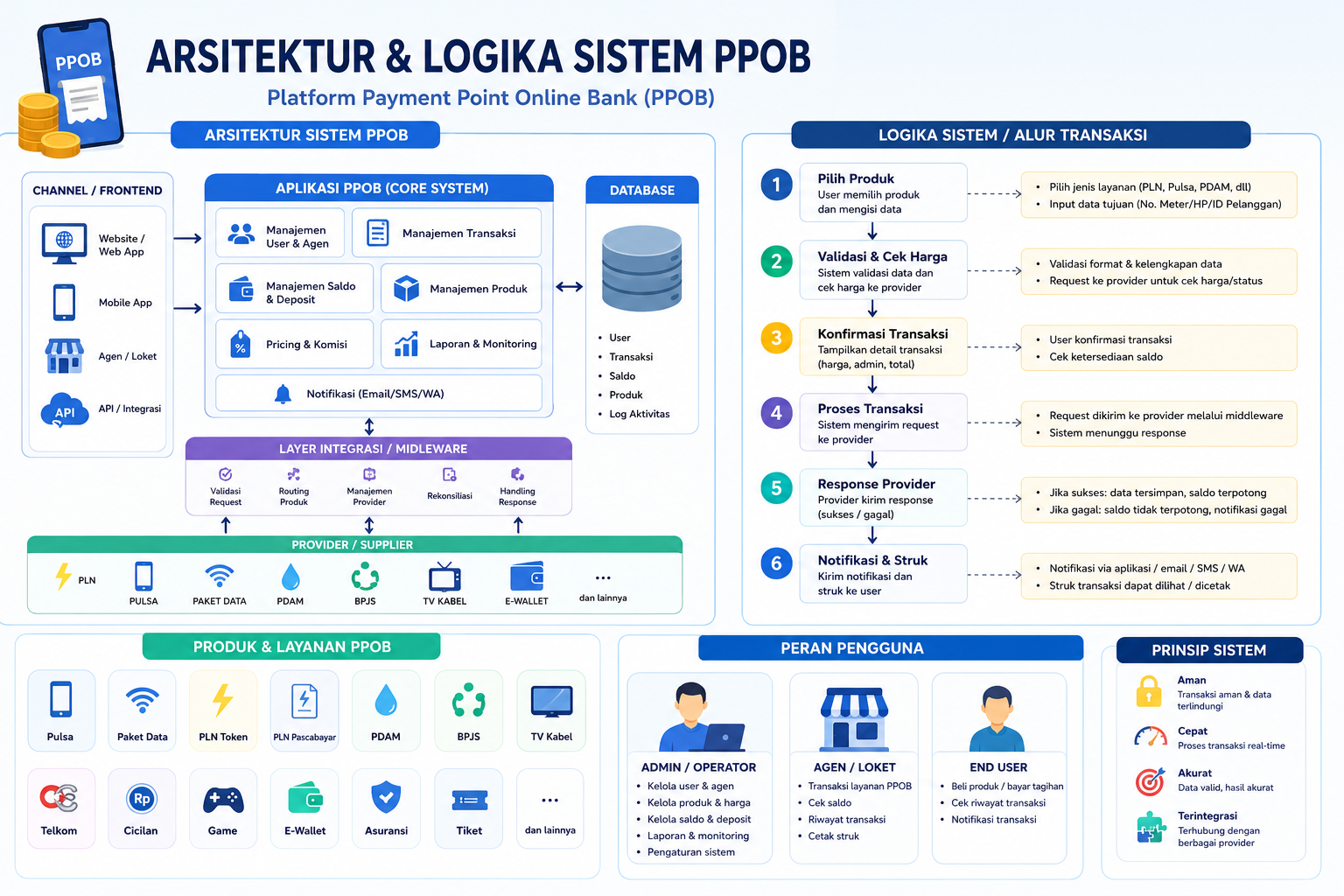
1. User Interface (UI) / Access Layer
- Agent/Merchant Portal: Web-based or mobile applications used by PPOB agents (e.g., small shops, kiosks) to process transactions for customers. This layer needs to be user-friendly, secure, and robust enough to handle various transaction types.
- Consumer Applications: Increasingly, PPOB services are integrated into mobile banking apps, e-wallets, or dedicated PPOB consumer apps, allowing end-users to perform transactions directly.
- API for Integrators: Provides programmatic access for third-party developers (e.g., e-commerce platforms, other fintech companies) to embed PPOB functionalities into their own applications.
2. API Gateway & Integration Layer
This is the central nervous system that connects the PPOB system to various external entities. It acts as a bridge, translating and routing requests between the PPOB core system and a multitude of billers, banks, and other service providers.
- Biller Integration: Connects to utility companies (electricity, water), telecommunication providers, internet service providers, insurance companies, and other entities whose bills or services are being paid. This involves specific APIs and data formats unique to each biller.
- Banking Integration: Establishes secure connections with various banks for settlement, real-time balance inquiries, and transaction reversals. This often involves standardized financial messaging protocols (e.g., ISO 20022).
- Payment Gateway Integration: May integrate with broader payment gateways to support diverse payment methods beyond direct bank transfers, such as credit cards or other e-wallets.
3. Core Transaction Processing Engine
This is the heart of the PPOB system, where the actual logic for processing transactions resides. It orchestrates the entire lifecycle of a payment from initiation to completion.
- Transaction Validator: Verifies the integrity and validity of incoming requests (e.g., correct biller code, valid account number, sufficient funds).
- Routing Module: Directs transactions to the appropriate biller or bank based on predefined rules and configurations.
- Execution Module: Initiates and monitors the actual payment transfer, interacting with the integrated biller/banking systems.
- Status Manager: Tracks the real-time status of each transaction (pending, successful, failed, reversed) and updates relevant databases.
- Reconciliation Engine: Ensures that all transactions are accurately recorded and matched between the PPOB system, billers, and banks, crucial for financial integrity.
4. Database Management System (DBMS)
A robust and highly available database is essential for storing all critical information.
- Customer & Agent Data: User profiles, agent details, authentication credentials.
- Transaction Records: Detailed logs of every transaction, including time, amount, status, participant IDs, and unique transaction identifiers.
- Biller & Service Catalogs: Information about all available billers, their services, pricing, and integration parameters.
- Security Logs: Records of all system access, attempts, and changes for audit and security purposes.
5. Security & Fraud Detection Module
Given the sensitive nature of financial transactions, security is paramount.
- Authentication & Authorization: Strong mechanisms (e.g., multi-factor authentication, role-based access control) to ensure only authorized users and systems can initiate or modify transactions.
- Data Encryption: All sensitive data, both in transit and at rest, is encrypted using industry-standard protocols.
- Fraud Detection Systems: Utilizes rules-based engines, behavioral analytics, and increasingly AI/ML to detect and prevent fraudulent activities in real-time.
- Audit Trails: Comprehensive logging of all activities for regulatory compliance and forensic analysis.
6. Reporting & Analytics Module
Provides insights into system performance, transaction volumes, agent performance, and customer behavior.
- Real-time Dashboards: For operational monitoring.
- Customizable Reports: For business intelligence and strategic decision-making.
- Alerts & Notifications: For critical system events or anomalies.
The Intricate Logic: How PPOB Bridges the Divide
The true genius of PPOB systems lies not just in their components, but in the operational logic that binds them, creating a seamless financial bridge. This logic addresses several key challenges inherent in uniting traditional and digital financial services.
Real-time Transaction Processing and Validation
PPOB systems are designed for near real-time processing. When a customer pays a bill, the system doesn't just record the payment; it often validates the bill details directly with the biller's system in real-time. This immediate validation ensures accuracy and prevents issues like paying an already settled bill or an incorrect amount. The confirmation of payment is usually instantaneous, providing immediate peace of mind to the user.
Ensuring Reliability and Redundancy
The logic incorporates mechanisms for high availability. This includes redundant servers, load balancing, and failover strategies. If one component or server goes offline, another immediately takes its place, ensuring continuous service. This resilience is critical for a system handling vital daily transactions.
Scalability for Growth
A well-architected PPOB system is inherently scalable. Its logic allows for the easy addition of new billers, services, agents, and increased transaction volumes without a significant overhaul of the core infrastructure. This modular design means new APIs and integration endpoints can be added incrementally, supporting rapid expansion as digital adoption grows.
Robust Security Protocols
The operational logic integrates layers of security at every step. From encrypted communication channels (SSL/TLS) between components to secure data storage and advanced intrusion detection systems, every measure is taken to protect sensitive financial data. The konvergensi antara keuangan tradisional dan ekosistem digital mandates stringent security to maintain trust across both realms.
Interoperability with Diverse Systems
Perhaps one of the most complex aspects of PPOB logic is its ability to interface with a myriad of external systems, each potentially having different technical specifications, data formats, and communication protocols. The API Gateway acts as a universal translator, standardizing communication and enabling seamless data exchange between the PPOB core and external billers or banks. This interoperability is fundamental to its role as a digital financial nexus.
Facilitating Financial Inclusion
PPOB systems play a pivotal role in financial inclusion. By enabling transactions through agent networks in remote or underserved areas, they extend essential financial services to populations that may lack direct access to banks or even stable internet connectivity. The logic here involves simplified interfaces for agents, robust offline capabilities for transaction caching, and efficient synchronization mechanisms once connectivity is re-established.
Challenges and Future Innovations
Despite their sophistication, PPOB systems face continuous challenges:
- Legacy System Integration: Many billers and banks still operate on older, less flexible systems, making integration complex and resource-intensive.
- Evolving Security Threats: As cyber threats become more sophisticated, PPOB systems must constantly update their security protocols and fraud detection capabilities.
- Regulatory Compliance: Navigating diverse and changing financial regulations across different jurisdictions adds another layer of complexity.
- Keeping Pace with Consumer Expectations: Users expect ever faster, more convenient, and personalized services, pushing PPOB developers to innovate continuously.
Future innovations in PPOB architecture and logic are likely to include:
- Greater Adoption of AI and Machine Learning: For enhanced fraud detection, predictive analytics, and personalized service recommendations.
- Blockchain for Transparency and Efficiency: Exploring distributed ledger technologies for more secure, transparent, and efficient inter-bank settlements and reconciliation.
- Open Banking Integration: Leveraging open APIs to create more integrated and customizable financial experiences.
- Cloud-Native Architectures: Moving towards microservices and serverless computing for even greater scalability, resilience, and cost-effectiveness.
Conclusion
The architecture and logic of PPOB systems are a testament to the ingenuity required to build resilient digital infrastructure in a hybrid financial world. They are the unseen nexus, tirelessly working to connect traditional financial practices with the demands of the digital age, enabling millions of transactions daily and fostering greater financial inclusion. By understanding their intricate design and operational principles, we gain a deeper appreciation for the complex interplay of technology that underpins our modern digital economy. PPOB is not just a system; it is a foundational pillar bridging past and future, tradition and innovation, in the ongoing evolution of global finance.