Unveiling the Digital Backbone: A Deep Dive into PPOB System Architecture & Logic | 揭秘数字骨干:PPOB系统架构与逻辑深度解析
Unveiling the Digital Backbone: A Deep Dive into PPOB System Architecture & Logic
In the rapidly evolving landscape of digital finance, Payment Point Online Bank (PPOB) systems have emerged as pivotal infrastructure, facilitating seamless bill payments and purchases for millions. While the end-user experience is often characterized by simplicity and convenience, the underlying architecture and logic of a robust PPOB system are remarkably complex, intricate, and meticulously engineered. This article delves into the sophisticated design principles, core components, and operational logic that constitute the digital backbone of modern PPOB systems, offering a unique perspective on their critical role in fostering financial inclusion and driving digital economies.
揭秘数字骨干:PPOB系统架构与逻辑深度解析
在快速发展的数字金融格局中,支付点在线银行(PPOB)系统已成为关键的基础设施,为数百万人提供无缝的账单支付和购买服务。尽管最终用户体验通常以简单和方便为特征,但一个强大PPOB系统底层的架构和逻辑却异常复杂、精巧且经过精心设计。本文将深入探讨构成现代PPOB系统数字骨干的复杂设计原则、核心组件和操作逻辑,从独特的角度阐述它们在促进金融普惠和推动数字经济发展中的关键作用。
The Genesis of Complexity: Why PPOB Demands Advanced Architecture
At its heart, a PPOB system acts as an aggregator and facilitator, connecting a diverse ecosystem of billers (utilities, telecommunications, insurance, e-commerce, etc.) with end-users through various payment channels. This seemingly straightforward function masks a multitude of challenges: real-time transaction processing, ensuring data accuracy across disparate systems, maintaining high levels of security, and achieving unparalleled scalability. The architecture must be resilient enough to handle fluctuating transaction volumes, flexible enough to integrate new services, and secure enough to protect sensitive financial data. The unique blend of high transaction throughput, diverse data formats, and the need for immediate reconciliation necessitates an architecture that goes beyond conventional payment gateways, focusing on robust integration and dynamic routing.
复杂性的起源:PPOB为何需要高级架构
从本质上讲,PPOB系统充当聚合器和协调者,通过各种支付渠道将账单方(公用事业、电信、保险、电子商务等)的多样化生态系统与最终用户连接起来。这种看似简单的功能掩盖了诸多挑战:实时交易处理、确保不同系统之间的数据准确性、保持高水平的安全性以及实现无与伦比的可扩展性。该架构必须足够强大以处理波动的交易量,足够灵活以集成新服务,并且足够安全以保护敏感的财务数据。高交易吞吐量、多样化的数据格式以及即时对账需求的独特结合,使得其架构必须超越传统的支付网关,专注于强大的集成和动态路由。
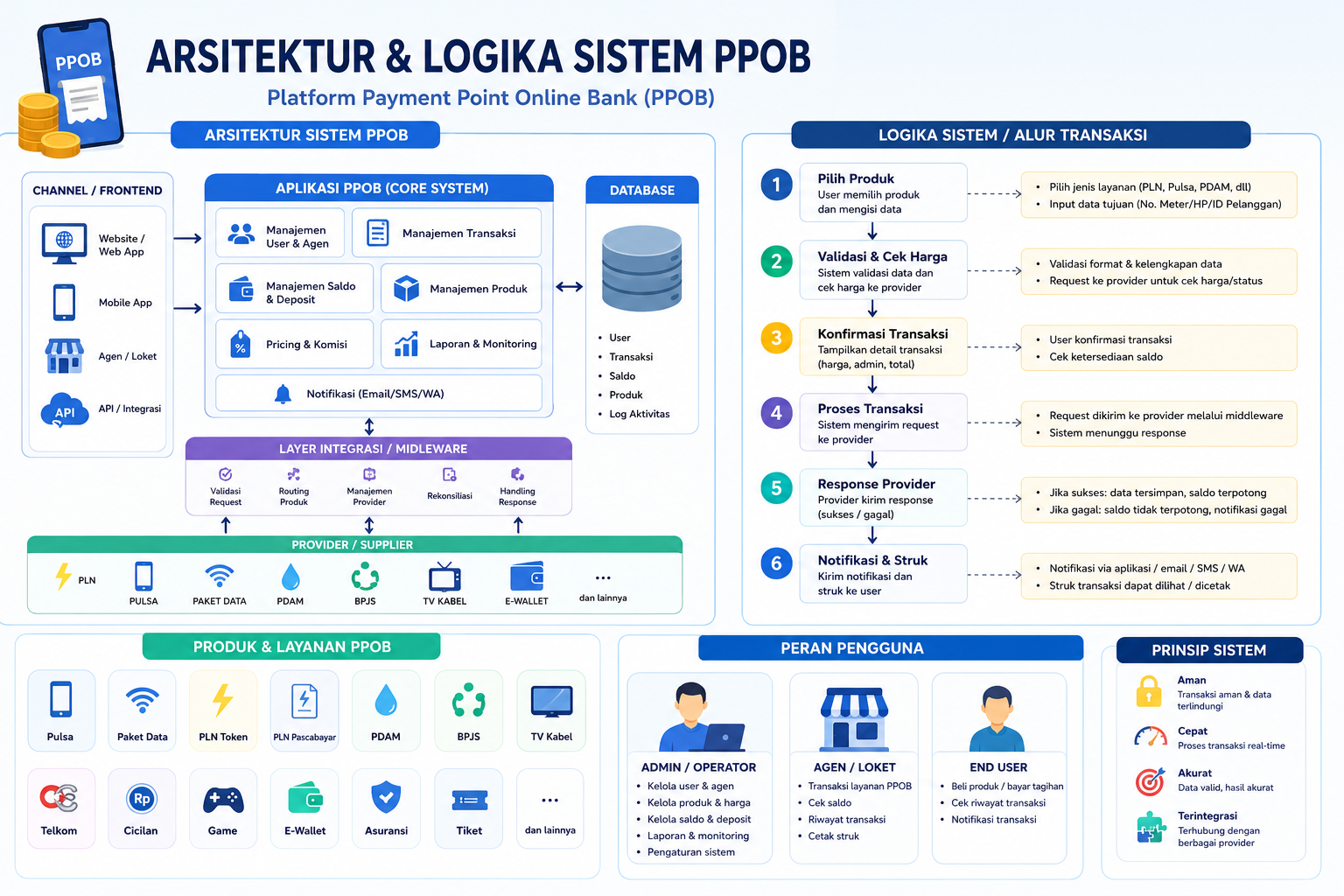
Core Architectural Components: Building Blocks of the PPOB Ecosystem
A well-designed PPOB system typically comprises several interconnected layers and modules, each with specific responsibilities. Understanding these components is key to appreciating the system's operational logic.
- Client/User Interface Layer: This is the entry point for end-users and agents. It can be a mobile application, a web portal, or a physical point-of-sale (POS) terminal. Its primary function is to collect user input (e.g., biller ID, account number, payment amount) and display transaction status.
- API Gateway & Front-end Services: This layer acts as the primary interface between the client layer and the core processing engine. It handles authentication, authorization, request validation, and rate limiting. It ensures that incoming requests are legitimate and properly formatted before forwarding them.
- Core Processing Engine (CPE): The heart of the PPOB system. It houses the business logic, transaction manager, and payment orchestrator. The CPE is responsible for:
- Transaction Management: Recording, tracking, and managing the lifecycle of each transaction (pending, success, failed, refunded).
- Business Logic: Applying rules for pricing, commissions, promotions, and service availability specific to each biller.
- Payment Orchestration: Selecting the optimal payment channel or method based on various parameters (e.g., user preference, cost, availability).
- Biller Integration Layer: This is arguably the most complex and critical layer. It facilitates communication with a multitude of external biller systems, each potentially having different APIs, data formats, and communication protocols (e.g., REST, SOAP, SFTP). This layer normalizes incoming and outgoing data, transforming it into a standardized format for the CPE.
- Database Layer: Stores all essential data, including:
- User profiles and agent accounts.
- Biller information and service configurations.
- Detailed transaction logs for audit, reconciliation, and reporting.
- Security credentials and configurations.
- Security & Fraud Detection Module: An overarching component that implements encryption (SSL/TLS), tokenization, multi-factor authentication, and real-time fraud monitoring algorithms to protect sensitive data and prevent illicit activities.
- Reporting & Analytics Engine: Processes transaction data to generate various reports (e.g., daily sales, commission statements, operational performance) and provides insights for business intelligence.
核心架构组件:PPOB生态系统的构建块
一个精心设计的PPOB系统通常由几个相互连接的层和模块组成,每个模块都有特定的职责。理解这些组件是理解系统操作逻辑的关键。
- 客户端/用户界面层: 这是最终用户和代理的入口点。它可以是移动应用程序、网络门户或物理销售点(POS)终端。其主要功能是收集用户输入(例如,账单方ID、账户号码、支付金额)并显示交易状态。
- API网关和前端服务: 该层充当客户端层和核心处理引擎之间的主要接口。它处理认证、授权、请求验证和速率限制。它确保传入请求在转发之前是合法且格式正确的。
- 核心处理引擎(CPE): PPOB系统的核心。它包含业务逻辑、交易管理器和支付协调器。CPE负责:
- 交易管理: 记录、跟踪和管理每个交易的生命周期(待处理、成功、失败、退款)。
- 业务逻辑: 应用特定于每个账单方的定价、佣金、促销和服务的可用性规则。
- 支付协调: 根据各种参数(例如,用户偏好、成本、可用性)选择最佳支付渠道或方法。
- 账单方集成层: 这可以说是最复杂和最关键的层。它促进与众多外部账单方系统之间的通信,每个系统可能具有不同的API、数据格式和通信协议(例如,REST、SOAP、SFTP)。该层对传入和传出数据进行标准化,将其转换为CPE的标准化格式。
- 数据库层: 存储所有基本数据,包括:
- 用户资料和代理账户。
- 账单方信息和服务配置。
- 用于审计、对账和报告的详细交易日志。
- 安全凭证和配置。
- 安全与欺诈检测模块: 一个全面的组件,实现加密(SSL/TLS)、令牌化、多因素认证和实时欺诈监控算法,以保护敏感数据并防止非法活动。
- 报告与分析引擎: 处理交易数据以生成各种报告(例如,每日销售、佣金报表、运营绩效)并为商业智能提供洞察。
The Logic Flow: A Transaction's Intricate Journey
To fully grasp PPOB system logic, let's trace a typical transaction: a user paying their electricity bill.
- Initiation: The user accesses the PPOB platform (via app or web), selects "electricity bill," and inputs their account number.
- Request Validation & Inquiry: The client sends the request to the API Gateway. The Gateway validates the input and forwards it to the CPE. The CPE then queries the Biller Integration Layer, which communicates with the electricity provider's system to fetch the bill details (amount due, due date, customer name).
- Response & Confirmation: The bill details are returned through the integration layer, CPE, and API Gateway to the user interface for confirmation.
- Payment Authorization: Upon user confirmation, the request (including payment method) is sent back. The CPE processes this, checks the user's balance (if using an e-wallet) or initiates a payment request to the chosen payment gateway (e.g., bank transfer, credit card).
- Payment Processing & Biller Update: Once the payment is authorized and processed (money deducted), the CPE instructs the Biller Integration Layer to notify the electricity provider's system that the bill has been paid. This update is often real-time or near real-time.
- Transaction Confirmation & Receipt: The electricity provider confirms the payment. This confirmation travels back through the PPOB system, and a successful transaction receipt is generated and displayed to the user. All these steps are meticulously logged in the Database Layer.
- Reconciliation: Behind the scenes, the PPOB system's logic performs ongoing reconciliation between its internal transaction records and the confirmations received from billers and payment channels to ensure financial accuracy. For a deeper understanding of these end-to-end processes, one might explore resources on understanding comprehensive payment processes in PPOB systems.
逻辑流:交易的复杂旅程
为了全面掌握PPOB系统逻辑,让我们追溯一个典型的交易:用户支付电费。
- 发起: 用户通过PPOB平台(通过应用程序或网络)访问,选择“电费”,并输入其账户号码。
- 请求验证和查询: 客户端将请求发送到API网关。网关验证输入并将其转发到CPE。CPE随后查询账单方集成层,该层与电力供应商系统通信以获取账单详情(应付金额、截止日期、客户姓名)。
- 响应和确认: 账单详情通过集成层、CPE和API网关返回到用户界面以进行确认。
- 支付授权: 用户确认后,请求(包括支付方式)被发送回去。CPE处理此请求,检查用户余额(如果使用电子钱包)或向选择的支付网关(例如,银行转账、信用卡)发起支付请求。
- 支付处理和账单方更新: 一旦支付获得授权并处理(款项扣除),CPE指示账单方集成层通知电力供应商系统账单已支付。此更新通常是实时或近实时的。
- 交易确认和收据: 电力供应商确认支付。此确认通过PPOB系统返回,并生成成功的交易收据并显示给用户。所有这些步骤都在数据库层中进行详细记录。
- 对账: 在幕后,PPOB系统的逻辑在其内部交易记录与从账单方和支付渠道收到的确认之间进行持续对账,以确保财务准确性。
Key Architectural Principles and Logic Considerations
The resilience and effectiveness of a PPOB system hinge on adherence to several critical architectural and logical principles:
- Scalability: The ability to handle a rapidly increasing number of transactions and users without compromising performance. This often involves microservices architecture, load balancing, and distributed databases.
- Reliability & High Availability: Ensuring continuous service operation with minimal downtime. Redundant systems, failover mechanisms, and robust error handling are paramount.
- Security: Protecting sensitive financial data from cyber threats. This includes end-to-end encryption, strong authentication mechanisms, regular security audits, and compliance with industry standards (e.g., PCI DSS).
- Flexibility & Extensibility: The ease with which new billers, payment methods, or services can be integrated without significant system overhauls. A well-designed API layer and modular components are crucial here.
- Real-time Processing: Many PPOB services require immediate updates and confirmations. The architecture must support low-latency communication and processing.
- Data Integrity & Consistency: Maintaining accurate and consistent data across all systems, especially during complex multi-party transactions, is vital for trust and operational efficiency.
关键架构原则和逻辑考量
PPOB系统的韧性和有效性取决于遵循几个关键的架构和逻辑原则:
- 可扩展性: 在不影响性能的情况下处理迅速增长的交易和用户数量的能力。这通常涉及微服务架构、负载均衡和分布式数据库。
- 可靠性与高可用性: 确保服务持续运行,停机时间最短。冗余系统、故障转移机制和强大的错误处理至关重要。
- 安全性: 保护敏感财务数据免受网络威胁。这包括端到端加密、强大的认证机制、定期的安全审计以及遵守行业标准(例如PCI DSS)。
- 灵活性和可扩展性: 轻松集成新的账单方、支付方式或服务而无需进行重大系统改造的能力。设计良好的API层和模块化组件在此处至关重要。
- 实时处理: 许多PPOB服务需要即时更新和确认。架构必须支持低延迟通信和处理。
- 数据完整性与一致性: 在所有系统中保持准确和一致的数据,尤其是在复杂的多方交易中,对于信任和运营效率至关重要。
Challenges and Future Innovations in PPOB Architecture
The journey of PPOB architecture is not without its hurdles. Integrating with legacy systems of older billers, managing an ever-growing array of payment methods (including cryptocurrencies and emerging digital wallets), and combating increasingly sophisticated fraud attempts are ongoing challenges. However, these challenges also fuel innovation. Modern PPOB systems are increasingly adopting:
- Microservices Architecture: Breaking down monolithic systems into smaller, independently deployable services enhances scalability, fault isolation, and development agility.
- Cloud-Native Deployment: Leveraging cloud computing platforms (AWS, Azure, GCP) for elasticity, managed services, and global reach.
- Artificial Intelligence & Machine Learning: Implementing AI/ML for enhanced fraud detection, predictive analytics for load balancing, and personalized user experiences.
- Blockchain & Distributed Ledger Technology: Exploring DLT for secure, transparent, and immutable transaction records, particularly for cross-border payments or complex multi-party settlements.
- Open Banking APIs: Adopting standards that allow for seamless and secure data sharing with other financial institutions, further enriching the PPOB ecosystem.
The continuous evolution of PPOB system architecture and logic is pivotal for financial inclusion and the growth of digital economies, as evidenced by its transformative impact in regions like Indonesia, where it acts as a digital financial bridge for millions.
PPOB架构的挑战与未来创新
PPOB架构的发展并非没有障碍。与老旧账单方的遗留系统集成、管理日益增长的支付方式(包括加密货币和新兴数字钱包),以及对抗日益复杂的欺诈尝试都是持续的挑战。然而,这些挑战也推动了创新。现代PPOB系统正日益采用:
- 微服务架构: 将单一系统分解为更小、可独立部署的服务,增强可扩展性、故障隔离和开发敏捷性。
- 云原生部署: 利用云计算平台(AWS、Azure、GCP)实现弹性、托管服务和全球覆盖。
- 人工智能和机器学习: 实施AI/ML以增强欺诈检测、用于负载均衡的预测分析以及个性化用户体验。
- 区块链和分布式账本技术: 探索DLT以实现安全、透明和不可变的交易记录,特别是对于跨境支付或复杂的多方结算。
- 开放银行API: 采用允许与其他金融机构无缝安全共享数据的标准,进一步丰富PPOB生态系统。
Conclusion
The unassuming act of paying a utility bill through a PPOB system is, in reality, the culmination of sophisticated engineering. The architecture and logic behind PPOB systems are a testament to modern software design principles, balancing complexity with user-friendliness, security with accessibility, and scalability with reliability. As digital payments continue to permeate every aspect of daily life, the robustness and adaptability of PPOB architecture will remain a cornerstone, empowering individuals and businesses alike in the ever-expanding digital economy. Its role as a critical enabler of digital transactions underscores the profound importance of continually refining its intricate design to meet future demands and foster an even more inclusive and efficient financial landscape.
结论
通过PPOB系统支付水电费这一看似简单的行为,实际上是复杂工程的结晶。PPOB系统背后的架构和逻辑是现代软件设计原则的证明,它在复杂性与用户友好性、安全性与可访问性、可扩展性与可靠性之间取得了平衡。随着数字支付继续渗透到日常生活的方方面面,PPOB架构的稳健性和适应性将仍然是基石,在不断扩大的数字经济中赋能个人和企业。它作为数字交易关键推动者的角色,强调了不断完善其复杂设计以满足未来需求并促进更具包容性和高效的金融格局的深远重要性。