The Invisible Orchestrator: How PPOB Systems Architect Resilient and Inclusive Digital Payment Ecosystems
The convenience of paying bills, topping up mobile credit, or purchasing digital vouchers with a few taps on a smartphone or a quick visit to a local agent has become a ubiquitous part of modern life for millions, particularly in emerging economies. Behind this seamless user experience lies a sophisticated, intricate network known as the Payment Point Online Bank (PPOB) system. Far from being a simple transaction portal, a PPOB system functions as an invisible orchestrator, meticulously designed with robust architecture and logical principles to facilitate a vast array of digital payments. This article delves into the profound complexities of the unseen nexus of digital payment systems, deconstructing its core architecture and the underlying logic that makes it a cornerstone of digital inclusion and economic growth. We will explore how these systems are engineered to be resilient, scalable, and secure, bridging the gap between diverse service providers and a broad user base.
What is PPOB? A Brief Overview of its Purpose
At its heart, a PPOB system aggregates various billing and payment services, allowing users to pay multiple types of bills (electricity, water, telephone, internet, insurance, etc.) and conduct other digital transactions (mobile top-ups, e-money loading) through a single platform or network of agents. It eliminates the need for users to interact directly with individual billers, streamlining the payment process significantly. The true genius of PPOB, however, lies not merely in aggregation but in the intricate dance of data, security, and financial reconciliation that occurs beneath the surface, ensuring every transaction is processed accurately and efficiently. This operational efficiency is paramount for regions where traditional banking infrastructure might be less developed, making digital access a crucial enabler for everyday life.
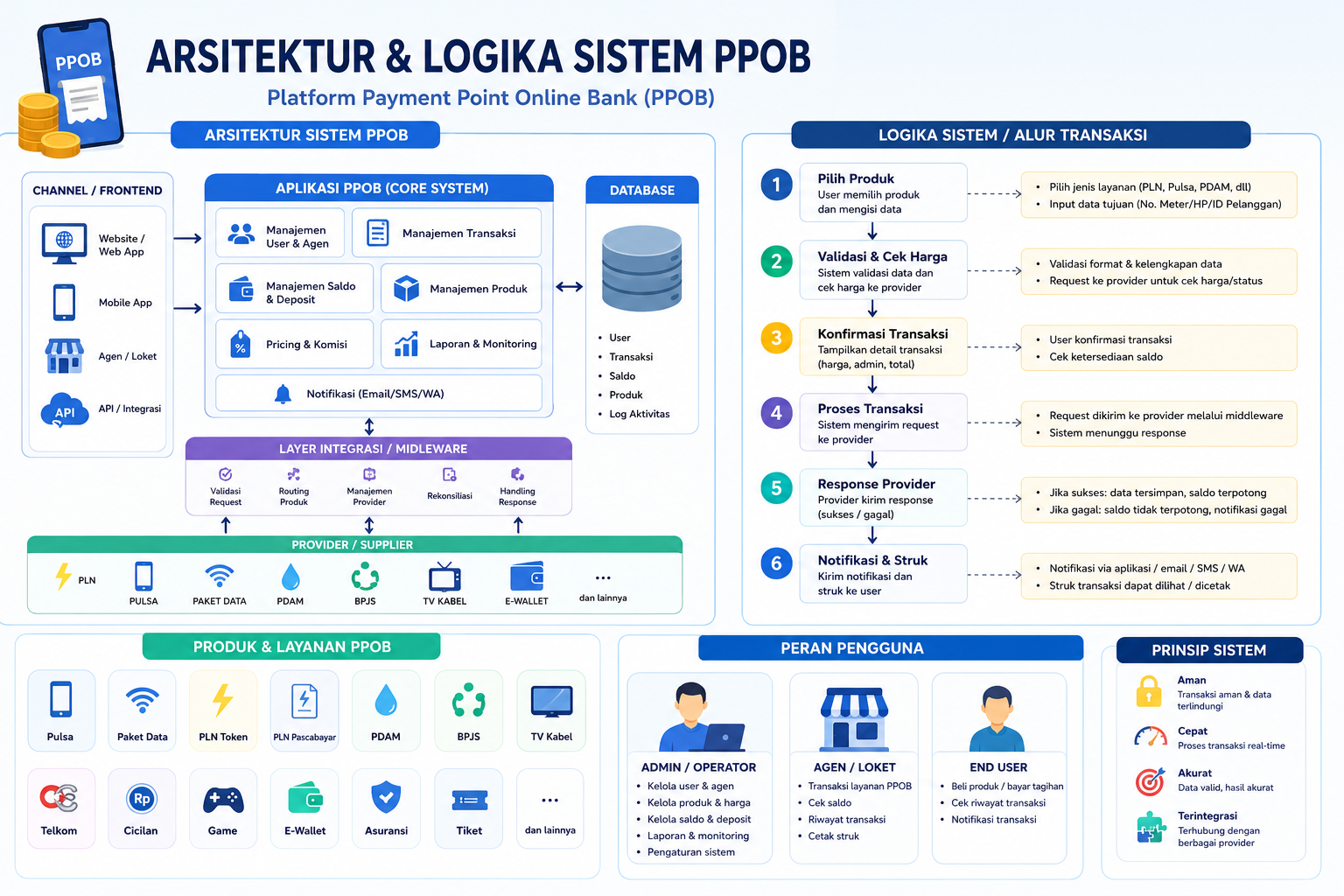
The Foundational Architecture: Building Blocks of a PPOB System
The architecture of a PPOB system is typically layered, designed for modularity, scalability, and resilience. Each layer performs specific functions, contributing to the overall stability and efficiency of the system.
1. The Presentation Layer (User Interface & API Gateway)
This is the outermost layer, directly interacting with end-users or partner applications. It includes:
- Web/Mobile Applications: User-facing interfaces for direct customer access. These applications are designed to be intuitive and accessible across various devices, providing a seamless experience for initiating payments.
- Agent Desktops/POS Terminals: Interfaces specifically designed for human agents in physical locations (e.g., small shops, dedicated kiosks) to process payments on behalf of customers. These terminals often have specific hardware and security considerations.
- API Gateway: A crucial component that acts as the single entry point for all external requests from partners (e.g., banks, e-wallets, other payment platforms, aggregators). It handles request routing, composition, and protocol translation, ensuring secure and standardized communication with the core system. This layer also manages authentication, authorization, rate limiting, and monitoring for external entities, safeguarding the backend.
2. The Business Logic Layer (Core Processing Engine)
Often considered the brain of the PPOB system, this layer houses the primary business rules and processes governing all transactions. It’s responsible for:
- Transaction Management: Orchestrating the entire lifecycle of a payment, from initiation through validation, authorization, and final completion. This includes managing states like pending, approved, failed, or reversed.
- Biller Integration Management: Handling the various communication protocols, data formats, and specific requirements for integrating with a diverse array of billers and service providers. This often involves a sophisticated mapping engine to translate internal system requests into the specific formats required by each external entity, ensuring compatibility despite varying standards.
- Pricing and Commission Engine: A dynamic module that calculates transaction fees for users, commissions for agents or sub-agents, and other financial parameters based on predefined rules, service types, and transaction volumes.
- Fraud Detection and Risk Management Modules: Implementing sophisticated algorithms and rule-based systems to identify and prevent suspicious activities, anomalous transaction patterns, or potential security breaches. This is a continuously evolving component, crucial for maintaining system integrity and user trust.
- Reporting and Analytics Module: Generating comprehensive data for operational insights, financial reconciliation, regulatory compliance, and business intelligence. This includes real-time dashboards for monitoring and historical reports for strategic planning.
3. The Data Layer (Database Management & Storage)
This layer is responsible for persistent storage of all critical information and is foundational to the system's operation. It typically comprises:
- Transactional Databases: High-performance databases (often relational like PostgreSQL, MySQL, or enterprise-grade systems like Oracle) storing real-time transaction data, user profiles, agent information, biller details, and system configurations. These are optimized for high-volume read and write operations, prioritizing consistency and availability.
- Reporting/Archival Databases: Separate databases or data warehouses designed for historical data, audit trails, and generating complex, analytical reports. These are often optimized for read-heavy operations and can employ different database technologies (e.g., columnar databases) for performance.
- Caching Mechanisms: In-memory data stores (e.g., Redis, Memcached) used to store frequently accessed but relatively static data (e.g., biller lists, agent profiles, common configurations). Caching significantly improves system performance by reducing database load and response times.
4. The Integration Layer (External Connectors)
This layer facilitates secure and reliable communication with external systems, which are vital for PPOB's functionality and its role as an aggregator:
- Biller APIs/Adapters: Custom-built connectors designed to integrate specifically with individual biller systems. Due to the varied standards and protocols (e.g., SOAP, REST, XML RPC, proprietary APIs) used by different billers, these adapters are often a complex and critical part of the integration process.
- Banking/Financial Institution Connectors: Secure links for automated settlement, disbursement, and fund management with banks, e-money issuers, and other financial entities. This involves adhering to strict financial industry protocols and security standards.
- Payment Gateway Integrations: Connections to other external payment processors or e-wallet platforms that serve as funding sources for user transactions, expanding the versatility and reach of the PPOB system.
The Underlying Logic: How Transactions Flow and Are Secured
Beyond the static architectural components, the operational logic defines how a PPOB system processes transactions, ensures data integrity, and maintains robust security. This intricate dance of processes ensures reliability and trust.
1. Transaction Initiation & Validation
A user or agent initiates a payment by providing essential details such as the biller ID, customer account number, and the intended amount. The system's first logical step is rigorous validation of these inputs against predefined rules (e.g., format, data type, range checks). Following this, the system queries the respective biller system (via the Integration Layer) to fetch the actual, real-time bill details. This crucial pre-payment step confirms the validity of the bill, the outstanding amount, and ensures the payment request is accurate, preventing erroneous or duplicate payments.
2. Authorization & Fund Deduction
Once the bill details are confirmed and presented to the user, the system verifies the availability of funds. This could be checking the user's e-wallet balance, querying a linked bank account, or verifying the agent's pre-funded balance. Upon successful fund verification and user confirmation, the system initiates the fund deduction process. This often involves secure, encrypted communication with internal ledgers and/or external financial institutions to debit the required amount, with transaction IDs and timestamps ensuring uniqueness and traceability.
3. Biller Payment & Confirmation
The core processing engine then sends a payment request to the relevant biller's system, providing all necessary transaction details and confirming that the funds have been secured. The biller's system processes this request, updates their records to reflect the payment, and sends back a confirmation of successful payment to the PPOB system. This critical two-way communication ensures that both the PPOB system and the biller's system are synchronized regarding the payment status, providing immediate feedback to the user.
4. Settlement & Reconciliation
This is a complex, backend financial process that happens periodically (e.g., daily, hourly, or even in near real-time, depending on the system's design and regulatory requirements). It involves:
- Matching Transactions: Systematically comparing all recorded transactions within the PPOB system with confirmations received from billers and fund deductions recorded with financial partners. This ensures that every transaction is accounted for.
- Fund Transfer: Aggregating all payments due to each biller over a specific period and initiating the transfer of the total net amount from the PPOB's settlement accounts to the respective biller accounts. Concurrently, commissions due to agents, sub-agents, or other partners are calculated and disbursed.
- Discrepancy Resolution: Identifying and resolving any mismatches, errors, or disputes that may occur during the transaction or settlement process. This often involves automated reconciliation engines flagged for manual intervention in complex or unusual cases. Precise and timely reconciliation is paramount for maintaining financial integrity, regulatory compliance, and trust among all stakeholders. For a deeper understanding of the digital heart driving Indonesia's financial inclusion, the underlying complexity of these systems cannot be overstated.
5. Security & Error Handling
Security is not an afterthought but is woven into every layer and logical step of a PPOB system. This includes robust data encryption (both in transit using TLS/SSL and at rest in databases), secure API endpoints with OAuth2 or API key authentication, multi-factor authentication for users and agents, regular security audits, penetration testing, and advanced fraud detection mechanisms. Error handling logic is equally robust, designed to manage various failure scenarios gracefully, such as network outages, biller system failures, or transaction reversals. This ensures data consistency even in adverse conditions and provides clear notifications to users and operators, preventing data loss and maintaining user confidence.
Key Logical Principles Driving PPOB System Design
Several overarching logical principles guide the design, development, and continuous evolution of PPOB systems, ensuring their long-term viability and impact:
- Scalability: Designed from the ground up to handle a rapidly growing number of users, transactions, and biller integrations without compromising performance or stability. This often involves adopting distributed architectures, microservices, load balancing, and leveraging cloud-native solutions that can dynamically scale resources.
- Reliability & Redundancy: Engineered with high availability in mind, incorporating failover mechanisms, redundant servers, data replication, and disaster recovery plans. This ensures continuous service availability, minimizing downtime even in the face of hardware failures, network interruptions, or unexpected events.
- Interoperability: The critical ability to seamlessly connect and communicate with a diverse and ever-expanding ecosystem of billers, banks, mobile operators, government agencies, and other third-party services. This is achieved through flexible API designs, adaptable integration modules, and adherence to industry standards where available.
- Data Integrity & Auditability: Strict protocols and mechanisms are implemented to ensure that all transaction data is accurate, consistent, and traceable. Every action, transaction, and system event is logged, providing a comprehensive, immutable audit trail essential for regulatory compliance, financial reporting, and efficient dispute resolution.
- User-Centricity: While the backend is inherently complex, the entire logical flow and architectural design are ultimately geared towards providing a simple, intuitive, and highly efficient experience for the end-user. This applies regardless of their technical proficiency, location, or access method (e.g., mobile app, web portal, or assisted through an agent).
PPOB as a Catalyst for Digital Inclusion
The sophisticated architecture and logic of PPOB systems extend far beyond mere technical achievement; they represent a powerful catalyst for digital and financial inclusion, particularly in developing regions. By aggregating disparate services into a single, accessible platform, PPOB systems empower individuals who might be unbanked or underbanked to participate actively in the digital economy. They provide convenient, localized access to essential services (like utility payments or mobile top-ups), reduce travel time and costs associated with physical payments, and foster trust in digital transactions among populations unfamiliar with traditional banking. This widespread accessibility, enabled by carefully engineered backend processes and front-end simplicity, transforms daily life and contributes significantly to the digital literacy and economic empowerment of communities.
Challenges and Future Trajectories
Despite their robust design, PPOB systems face continuous challenges. Managing the ever-increasing number of biller integrations with their varied technical specifications, adapting to evolving regulatory landscapes, combating sophisticated cyber threats, and ensuring ultra-low latency for real-time transactions at scale are ongoing battles for system architects. The future trajectory of PPOB systems likely involves further integration with emerging technologies such as Artificial Intelligence for enhanced fraud detection and personalized user experiences, blockchain for more secure and transparent reconciliation processes, and advanced data analytics for predictive insights into payment trends and consumer behavior. The core architectural and logical principles, however, will remain paramount as these systems continue to evolve, silently powering the digital economies of tomorrow.
Conclusion
The architecture and logic of PPOB systems are a testament to complex engineering serving simple, profound ends. They are the invisible digital gears turning behind every effortless bill payment, every mobile top-up, and every digital purchase. By understanding the intricate layers from the API gateway to the reconciliation engine, and the guiding principles of scalability, security, and interoperability, we gain appreciation for these silent orchestrators. PPOB systems are not just about processing transactions; they are about building resilient digital infrastructures that foster financial inclusion, drive economic activity, and ultimately, simplify and enrich the lives of millions, one digital payment at a time.